
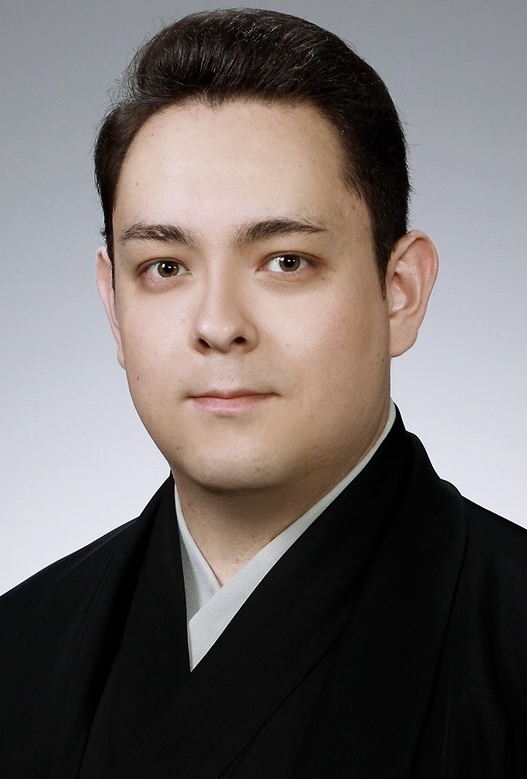
Profile:
Bryson Teruo Goda, is a 4th generation Japanese-American born and raised in Honolulu, Hawaii.
Nihon Buyō (Classical Japanese Dance) – Hanayagi Style
Hanayagi Mitsujyūrō
The path of training
Mitsujyūrō started his training in nihon buyō at the age of 4 under the instruction of Hanayagi Mitsuaki I, founder and first principal of the Hanayagi Dancing Academy, and furthered his dance training in Tokyo with Hanayagi Sanichirō, Hanayagi Isumi, Hanayagi Tomo, Hanayagi Kusumitsu, and Iemoto (headmaster) Hanayagi Jusuke IV.
Qualifications/Achievements
He was granted his natori name of Hanayagi Mitsujyūrō in 2011 and his shihan master license in 2014.
Mitsujyūrō has performed extensively in Japan and Hawaiʻi and was awarded the coveted Ikusei-sho by Hanayagi Jusuke IV as an up-and-coming performing artist, and is recognized for his role in preserving and perpetuating the traditions of Hanayagi-ryū in Hawaiʻi. Currently, he has granted one of his Hawaii students the titles of natori and shihan, respectfully.
Nurturing the next generation
Currently, he has granted one of his Hawaii students the titles of natori and shihan, respectfully.
Main appearances in recent years
Recent performances include a concert at the historic Hawaii Theatre in Honolulu and the Kabuki-za theater in Tokyo.
Nagauta Samon-Kai
Kineya Sakio
The path of training
Bryson began his rigorous training in nagauta shamisen at age six under Kineya Satoshi in Honolulu. Upon the passing of his teacher, at the age of fifteen, he continued his studies in Tokyo with the seventh-generation Samon-kai headmaster, Kineya Sakichi, and three years later received his professional name (natori), Kineya Sakio.
Qualifications/Achievements
In 2019, he was awarded the prestigious Master Instructor (shihan) certification by Sakichi VII.
Performance Credits
His performance credits include English-language Kabuki productions at the University of Hawai‘i at Mānoa, including Nozaki Village (2004), The Vengeful Sword (2013), and The Maiden Benten and the Bandits of the White Waves (2024). Recent highlights include NHK radio recordings and a 2026 performance at NHK Hall commemorating the Nagauta Association’s 100th anniversary.
Mission
An active member of the main Hanayagi school of classical Japanese dance, the Nihon Buyo Association, the Nagauta Samon-kai and the Nagauta Association in Japan, he performs regularly in both Hawai‘i and Japan on a regular basis.
Bryson’s goal is to be able to spread and share the classical performing arts of Japanese classical dance and Nagauta music to the people of the world.